
Ultrashort Introduction to Ultrafast Spectroscopy
Introduction
Ultrafast spectroscopy is a technique that uses ultrashort laser pulses (in the order of a picosecond, 10\(^{-12}\) s, or less) to investigate dynamics on timescales from attoseconds (10\(^{-18}\) s) to nanoseconds (10\(^{-9}\) s). This spectroscopy method could be used to study atoms, molecules, and charge carrier dynamics, which occur too quickly to measure using electronic devices.
The measurements are performed by using a sequence of ultrashort laser pulses to perturb the system from its equilibrium and record its state at a number of time delays to reconstruct the dynamics. It is necessary that the temporal width of the laser pulse is shorter or similar to the timescale of dynamics.
Experimental Setup
To conduct an ultrafast spectroscopy experiment, usually a titanium-sapphire (Ti:sapph) laser is a common source of ultrashort pulses. The laser is implemented in a regenerative amplifier with an optical parametric amplifier being used to tune the wavelength to the desired value.
The most common ultrafast spectroscopy experiment is ‘pump-probe,’ which is shown below.
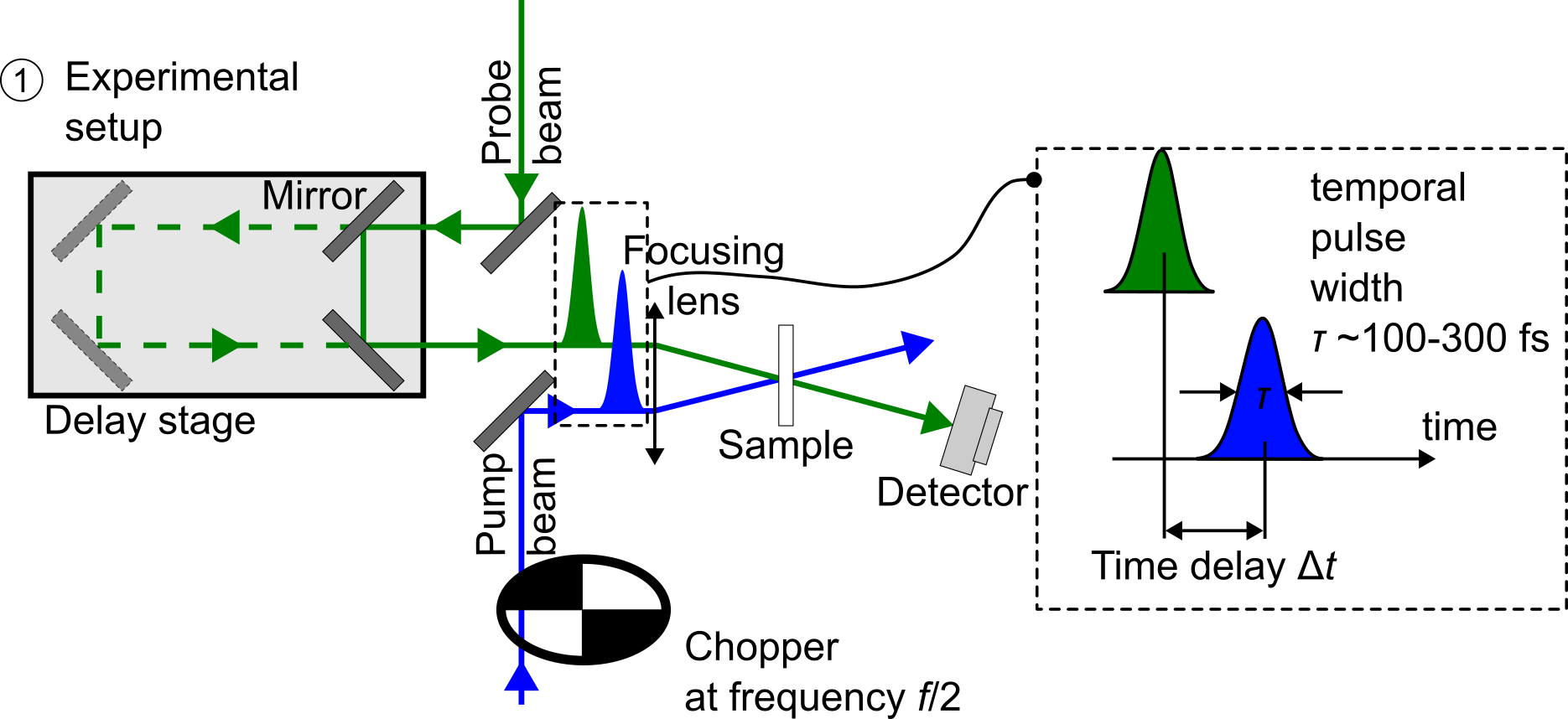
The pump pulse is used to excite electrons in the material, which means transferring them from their ground state to the higher energy states. A broadband probe pulse arrives some time \(\Delta t\) later, and its spectrum is monitored by the detector. The optical chopper is used to modulate the pump pulse, which allows obtaining pump-on, \(I_{pump\,on}\), and pump-off, \(I_{pump\,off}\), spectra continuously. The change in absorbance, \(\Delta A\) is worked out as \(\log_{10}(I_{pump\,off}/I_{pump\,on})\).
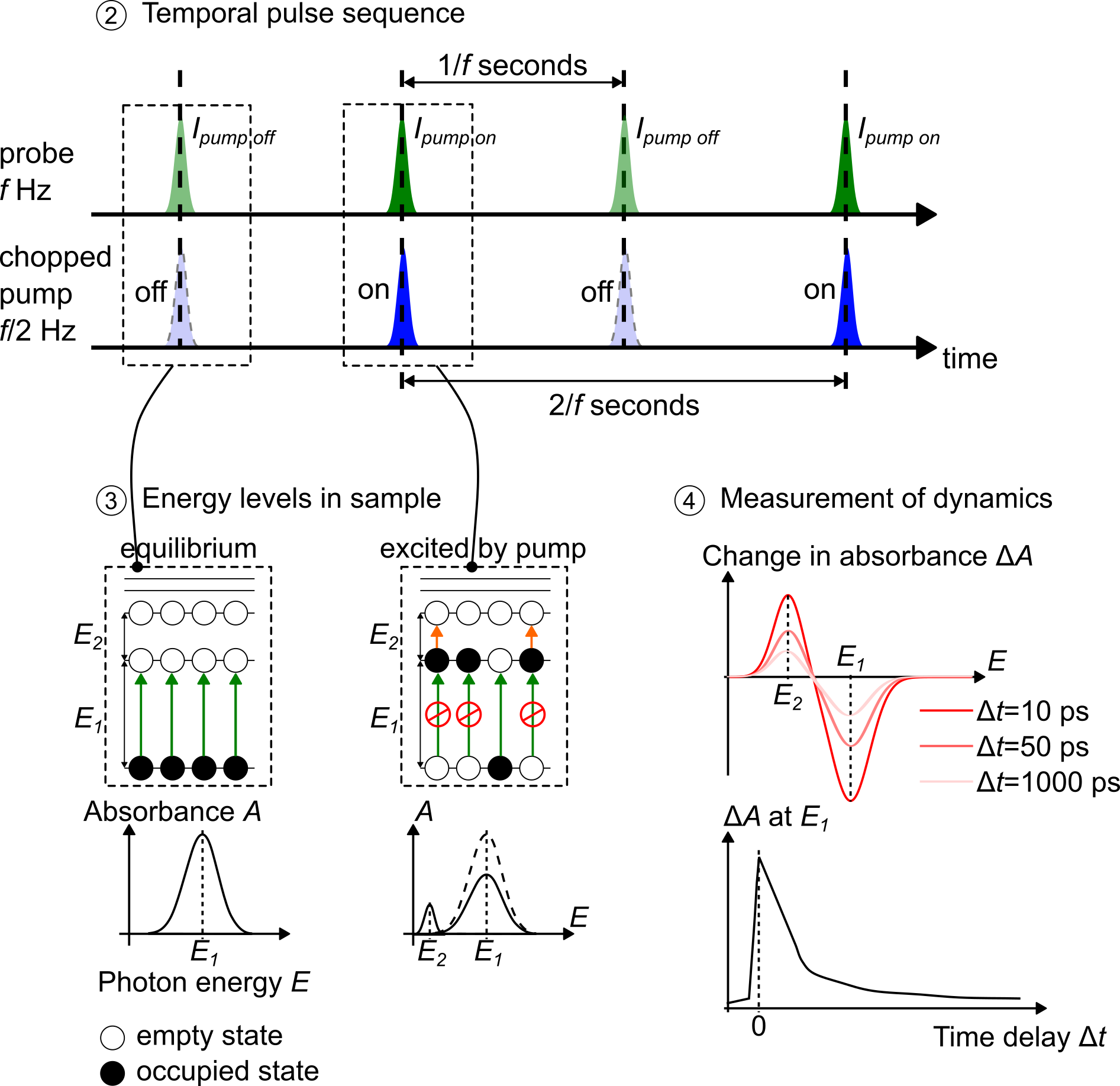
As the electrons in the excited material interact with the probe pulse, less light is absorbed at the photon energy \(E_1\) matching the transition (highlighted by green). The excited electrons may further absorb probe light; if there are higher energy states present, then electrons may absorb more light at the energy \(E_2\) (highlighted by an orange arrow). The difference between pump-on and pump-off spectra allows one to draw conclusions about the energy levels of the material.
Finally, the experiment is carried out many times at different delays \(\Delta t\) to reconstruct the time-resolved behaviour of the system. As time evolves, the excited electrons recombine, decreasing the change in absorbance \(\Delta A\).
Applications
The ultrafast spectroscopy is a useful technique to study ultrafast processes and has found many uses in science. For example, photodissociaion of chemical compounds, processes in biologically active molecules and charge carrier dynamics in perovskites.