
What is Perovskite?
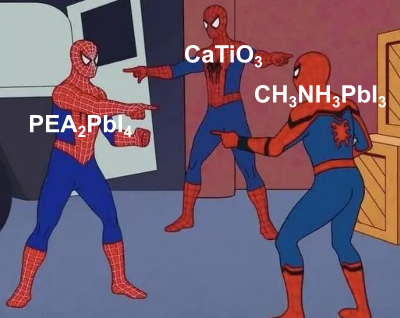
History
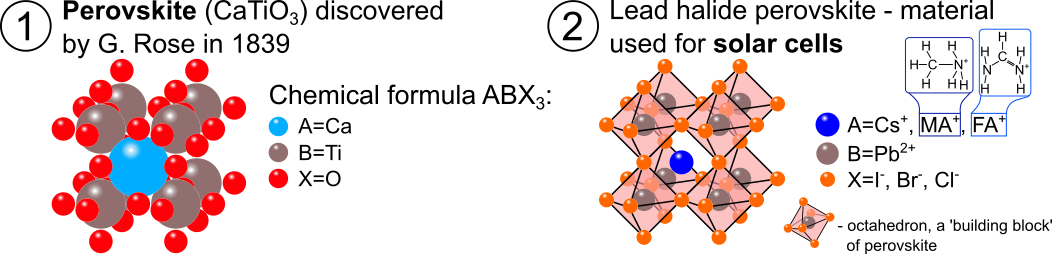
Gustav Rose discovered the calcium titanium oxide mineral (chemical formula CaTiO\(_3\)) in the Ural Mountains in 1839. He named the mineral ‘perovskite’ after Russian mineralogist Lev Perovski. These days, the name ‘perovskite’ is applied to the class of compounds that have similar crystal structure as CaTiO\(_3\) and have a general chemical formula. A\(^{2+}\)B\(^{4+}\)(X\(^{2-}\))\(_3\).
Synthetic perovskites lead halide perovskites
There is a large number of cations that can be used in this crystal structure, making perovskites diverse materials. Synthetic, such as lead halide, perovskites have been shown to be possible materials for photovoltaics, with a conversion efficiency of up to 26%, with methylammonium lead triodide (chemical formula CH\(_3\)NH\(_3\)PbI\(_3\)) being the most common studied material.
What makes lead halide perovskites great materials for solar cells?
There are three optoelectronic properties that make them perfect candidates for photovoltaics:
- High absorption coefficient \(\alpha\) of ~10\(^5\) cm\(^{-1}\): ensures all photons are absorbed and they generate electron-hole pairs.
- High mobility \(\mu\) of charge carriers in the range of 10-35 cm\(^2\)/(V s).
- Long electron-hole lifetime \(\tau\) up to 1 \(\mu\)s.
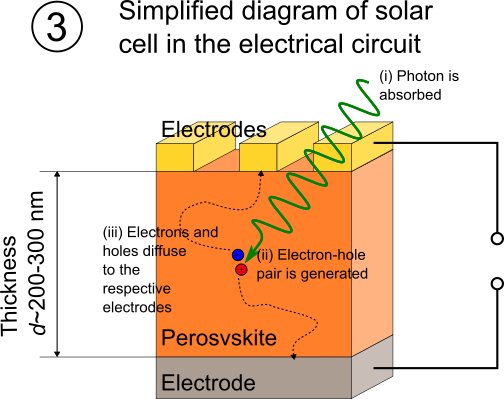
The mobility and lifetime are important parameters as they define the diffusion length of electrons and holes:
\(L_D = \sqrt{\frac{\mu k_B T \tau}{e}}\),
where \(k_B\) is the Boltzmann’s constant, \(T\) is temperature and \(e\) is the fundamental charge. The diffusion length describes the average distance that electrons and holes move away from each other before they recombine and give out a photon—the phenomenon that is not desirable in photovoltaics, as charge carriers do not contribute to the generated electrical current. Given the high mobility and lifetime of electron-hole pairs in lead halide perovskites, the diffusion length \(L_D\) is in the order of a few microns, which is much larger than a typical thickness of the perovskite thin film in a solar cell.
However, they are not widely used in industry due to the poor long-term stability as well as showing rapid degradation under humid environment.
Layered perovskites
Layered perovskites emerged as more stable alternatives to three-dimensional (3D) perovskites discussed before. Layered perovskites incorporate long organic cations in the crystal lattice, which forms layers of inorganic (lead halide) and organic parts. They have been shown to have increased moisture stability and suppress ion migration.
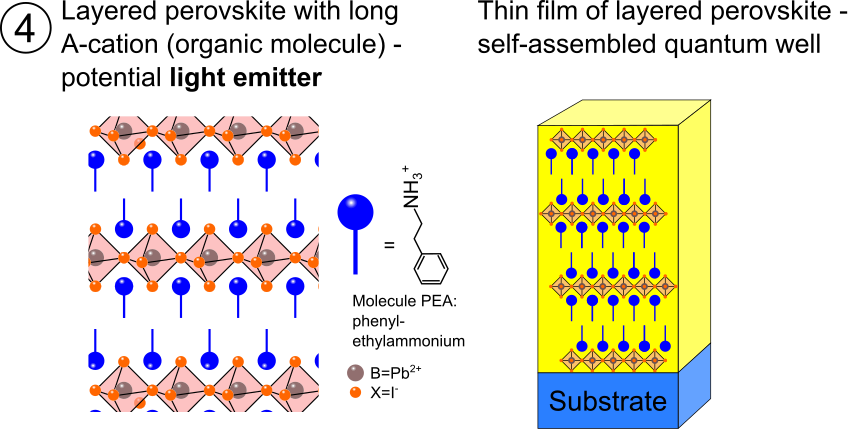
The inclusion of the long organic spacer alters structural properties dramatically. Furthermore, the fabrication of layered perovskite thin films results in self-assembled quantum wells, rather than polycrystalline films in the 3D perovskite case. This property allows the manifestation of quantum confinement effects, which have significant effects on the optoelectronic properties.
To elucidate the organic cation and inorganic lattice interaction in layered perovskites, we investigated both crystal structure and optoelectronic properties in a wide temperature range. More details could be found in this recently published paper!